ABNORMAL UTERINE BLEEDING: WARNING SIGNS THAT REQUIRE MEDICAL EVALUATION
8/26/2026 3:49:29 PM
Are your periods suddenly heavier, longer, arriving too early, or spaced further apart than usual? Or are you experiencing spotting between periods or bleeding after intercourse? Do not brush this off as a simple "hormonal imbalance."
Abnormal Uterine Bleeding (AUB) is vaginal bleeding from the uterus that differs in timing, duration, volume, or frequency from a normal menstrual cycle. Left unmanaged, AUB not only disrupts daily life and quality of living but may also indicate underlying gynecological conditions that require early detection and treatment.
Let's join CarePlus Gynecologists to understand the red flags, common causes, and when to proactively seek care to safeguard your reproductive health!
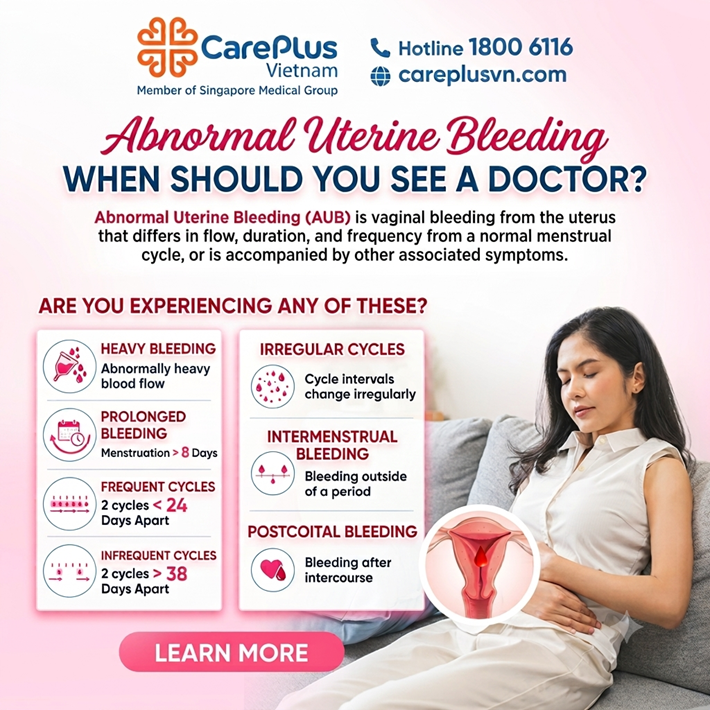
1. ABNORMAL UTERINE BLEEDING (AUB) – ARE YOU EXPERIENCING ANY OF THESE SIGNS?
🔴 Heavy Bleeding: A marked increase in menstrual blood flow that impacts daily activities.
🔴 Prolonged Bleeding: Menstruation lasting longer than 7 days.
🔴 Frequent Cycles: Menstrual cycles occurring less than 21 days apart.
🔴 Infrequent Cycles: Menstrual cycles occurring more than 35 days apart.
🔴 Irregular Cycles: Irregular variations in cycle intervals.
🔴 Intermenstrual Bleeding: Bleeding that occurs outside of normal periods.
🔴 Postcoital Bleeding: Bleeding following sexual intercourse, even in small amounts.
2. POTENTIAL CAUSES OF ABNORMAL UTERINE BLEEDING (AUB)
According to the FIGO PALM-COEIN classification system, potential causes include:
Structural Causes (PALM):
-
Endometrial polyps
-
Adenomyosis
-
Uterine leiomyomas (fibroids)
-
Endometrial hyperplasia or malignancy
Non-structural Causes (COEIN):
-
Coagulopathy
-
Ovulatory dysfunction
-
Endometrial disorders
-
Iatrogenic (medications or medical interventions)
-
Not yet classified
PROLONGED ABNORMAL UTERINE BLEEDING CAN CAUSE ANEMIA
Chronic blood loss can lead to fatigue, dizziness, lightheadedness, paleness, palpitations, rapid heart rate, poor concentration, and a significantly reduced quality of life.
3. WHEN SHOULD YOU SEE A DOCTOR?
You should proactively schedule an OB/GYN consultation if you experience:
-
Periods that are heavier or longer than usual
-
Cycles persistently shorter than 21 days or longer than 35 days
-
Intermenstrual or postcoital bleeding
-
Persistent or recurrent irregular menstrual cycles
-
Any postmenopausal vaginal bleeding
Emergency warning: Seek immediate emergency medical care if you experience unusually heavy bleeding (soaking through one sanitary pad per hour for two or more consecutive hours), accompanied by dizziness, lightheadedness, shortness of breath, or chest pain.
NEVER IGNORE POSTMENOPAUSAL BLEEDING
Even a single episode of minimal bleeding after menopause requires prompt medical evaluation. While benign causes like endometrial atrophy or polyps are common, underlying endometrial hyperplasia or malignancy must be ruled out.
4. HOW WILL DOCTORS IDENTIFY THE CAUSE?
Depending on individual clinical presentations, your physician may review cycle history, perform a pelvic exam, order a pregnancy test or complete blood count (CBC), conduct a pelvic ultrasound, or recommend targeted diagnostic procedures such as hysteroscopy or endometrial biopsy when clinically indicated.
Not all patients require every test; diagnostic approaches are tailored based on age, presenting symptoms, medical history, and specific risk factors.
Do not ignore changes in your menstrual cycle. Effective care involves both managing symptoms and pinpointing the root cause for appropriate treatment and long-term reproductive health protection.
If you are experiencing heavy bleeding, prolonged bleeding, spotting between periods, postcoital bleeding, or postmenopausal bleeding, proactively schedule an OB/GYN evaluation.
🔔 Explore CarePlus Comprehensive Gynecological Check-up Packages:
▶️ Comprehensive Gynecological Package for Single Women:
https://www.careplusvn.com/en/kham-phu-khoa-toan-dien-cho-nu-doc-than-3
▶️ Comprehensive Gynecological Package for Married Women:
https://www.careplusvn.com/en/kham-phu-khoa-toan-dien-cho-nu-co-gia-dinh-3
REFERENCES
-
American College of Obstetricians and Gynecologists (ACOG). Abnormal Uterine Bleeding.
-
ACOG. Perimenopausal Bleeding and Bleeding After Menopause.
-
National Institute for Health and Care Excellence (NICE). Heavy menstrual bleeding: assessment and management [NG88].
-
ACOG. Endometrial Hyperplasia.
-
Gynecological Lectures, University of Medicine and Pharmacy at Ho Chi Minh City.