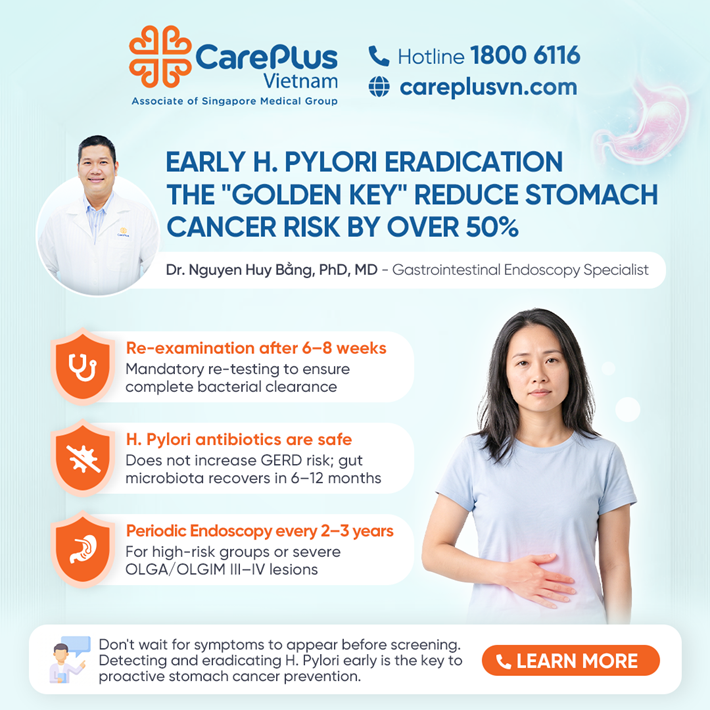
EARLY H. PYLORI ERADICATION: THE "GOLDEN KEY" TO REDUCING STOMACH CANCER RISK BY OVER 50%
9/30/2026 5:30:51 PM
🦠 HOW DANGEROUS IS H. PYLORI (HELICOBACTER PYLORI)?
Stomach cancer is currently one of the top 5 most common cancers and a leading cause of cancer-related deaths worldwide. Helicobacter pylori (H. Pylori) bacteria have been identified as the primary cause, accounting for approximately 80% of gastric adenocarcinoma cases. Since 1994, the World Health Organization (WHO) has classified H. Pylori as a Group 1 carcinogen.
In Asia generally and Vietnam specifically, the H. Pylori infection rate among adults remains high, accompanied by a significant burden of stomach cancer. Therefore, updating the latest medical guidelines on H. Pylori screening and treatment plays a vital role in public health.
1️⃣ THE EARLIER H. PYLORI IS ERADICATED, THE HIGHER THE STOMACH CANCER PREVENTION EFFECTIVENESS
Large-scale studies indicate that eradicating H. Pylori helps:
• Reduce stomach cancer risk by approximately 47 - 53% compared to untreated individuals.
• Lower the mortality rate caused by stomach cancer.
• Achieve maximum protective efficacy when eradicated before precancerous lesions develop (such as gastric mucosal atrophy or intestinal metaplasia).
• Still provide benefits for older adults, though the degree of protection decreases as treatment is delayed.
👉 Important message: Don't wait until severe symptoms or advanced lesions appear to screen for H. Pylori. Early detection and treatment are the keys to proactive stomach cancer prevention.
2️⃣ WHO SHOULD UNDERGO H. PYLORI SCREENING?
According to the latest recommendations, high-priority candidates for H. Pylori screening include:
• Individuals living in regions with high stomach cancer rates (such as Vietnam and many other Asian countries).
• Individuals with first-degree relatives (parents, siblings, children) who have had stomach cancer.
• Individuals experiencing alarm symptoms: persistent epigastric pain, unexplained weight loss, difficulty swallowing, early satiety, iron deficiency anemia, or gastrointestinal bleeding.
• Immigrants moving from regions with high stomach cancer incidence to areas with lower rates (their risk remains higher than the native population).
👉 Regarding age, cost-effectiveness analyses show that the 35 - 45 age mark is a reasonable milestone to start screening in many populations. While there is no universal consensus on the absolute optimal age, the general rule remains "the earlier, the better."
3️⃣ CONFIRMATORY POST-TREATMENT TESTING IS MANDATORY
A crucial highlight of the updated guidelines is: Successful H. Pylori eradication should not be assumed based solely on symptom relief.
Confirmatory testing is mandatory 6–8 weeks post-treatment to:
• Ensure actual treatment efficacy.
• Reduce ulcer recurrence risk (duodenal ulcer recurrence rate drops significantly from 67% down to 6% after successful eradication).
• Avoid unnecessary re-treatment, helping to minimize antibiotic resistance.
4️⃣ ADDRESSING COMMON CONCERNS ABOUT H. PYLORI TREATMENT
Many people worry that using antibiotics to treat H. Pylori causes long-term side effects. The updated recommendations offer notable evidence:
• Does not increase the risk of gastroesophageal reflux disease (GERD).
• Does not increase the risk of esophageal adenocarcinoma.
• Gut microbiota may be temporarily disrupted post-treatment, but typically recovers within 6 - 12 months.
5️⃣ WHEN SHOULD YOU UNDERGO GASTRIC ENDOSCOPY AFTER AN H. PYLORI DIAGNOSIS?
Upper gastrointestinal endoscopy is recommended for H. Pylori-infected individuals who have:
• High risk of stomach cancer (family history, advanced age).
• Alarm symptoms listed above.
Following endoscopy, if severe gastric mucosal atrophy or intestinal metaplasia is detected (OLGA/OLGIM stage III - IV), periodic endoscopic surveillance every 2–3 years is required even after successful H. Pylori eradication because stomach cancer risk persists in patients with precancerous lesions.
🛡️ DON'T TAKE H. PYLORI LIGHTLY
The Taipei Global Consensus II reaffirms: "Eradicating Helicobacter pylori is an effective strategy for stomach cancer prevention and should be performed for all adults infected with H. Pylori," especially those in high-risk groups. The earlier the intervention before precancerous lesions develop the greater the preventive benefit.
📍 If you are experiencing persistent stomach pain, have a family history of stomach cancer, or simply want to proactively screen your digestive health, book a consultation and endoscopy at CarePlus to receive a personalized screening and treatment regimen from our specialists.