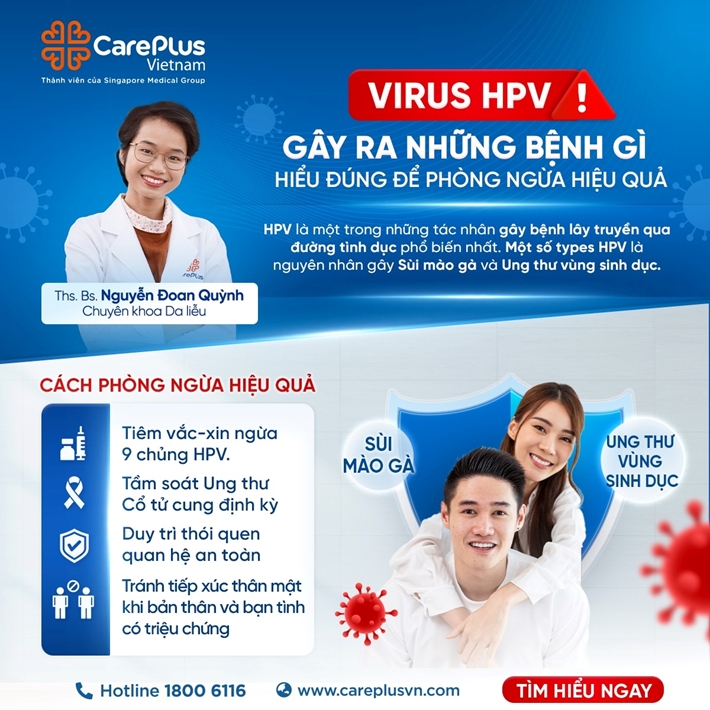
WHAT DISEASES DOES HPV CAUSE? UNDERSTAND CORRECTLY FOR EFFECTIVE PREVENTION!
12/10/2025 11:07:58 AM
HPV is one of the most common sexually transmitted pathogens. The term “HPV” refers to a group of viruses that share similar structural characteristics and mechanisms of infection. Certain HPV types are responsible for genital warts and cancers of the anogenital region.
This article is written by MSc., MD. Nguyễn Đoan Quỳnh – Dermatology Specialist, CarePlus Clinic International – to help everyone understand HPV correctly and prevent it effectively.
1. Do all HPV types cause cancer?
Most HPV types do not cause disease in humans.
On the skin, some HPV types may cause common warts.
In the anogenital and oropharyngeal regions (genitals, anus, throat, mouth):
-
Some types cause genital warts (types 6, 11).
-
Other types cause epithelial cancers (types 16, 18, 31, 33, 35, 39, 45, 51, 52, 56, 58, 59).
-
HPV types that cause genital warts typically do not cause epithelial cancers.
2. Symptoms of HPV infection
Most individuals infected with HPV have no symptoms.
Contrary to older beliefs that HPV persists for life once infected, recent studies confirm that about 90% of HPV infections clear spontaneously within approximately 2 years. Among the remaining 10%, HPV may cause symptoms depending on the type present at the infection site.
In sexually active regions, the two most common diseases caused by HPV are cervical cancer and genital warts.
Patients should seek medical evaluation if they notice one or multiple papules, growths, or lesions, painful or painless, in sexual contact areas (genitals, anus, throat, mouth).Typical genital warts appear as cauliflower-like papillary lesions. The number may be single or multiple, and over time they may regress, remain the same, or increase.
Cancers of the anogenital region caused by HPV are usually more silent, often asymptomatic in early stages.
-
Women (later stages): abnormal vaginal discharge, abnormal vaginal bleeding, pain during intercourse, lower abdominal pain.
-
Men: painful papules or plaques, discharge, or persistent non-healing lesions (>4 weeks) on the penis.
-
Individuals having receptive anal intercourse: anal itching, discharge, bleeding, worsening symptoms during bowel movements.
3. Transmission
HPV is transmitted from an infected person to their partner through sexual contact (vaginal, anal, or oral). A person with HPV can transmit the virus even when asymptomatic.
4. Testing and Diagnosis
-
HPV testing (for certain high-risk types) is part of the cervical cancer screening protocol for women.
-
This test is not yet officially approved for routine use in men.
-
Genital warts are primarily diagnosed based on clinical examination. Additional tests may be used when clinical presentation is atypical.
5. Treatment of HPV infection
-
As mentioned, most HPV infections clear spontaneously within 2 years.
Persistent infections that manifest as conditions such as genital warts or HPV-related cancers require disease-specific treatment.
6. Prevention
-
HPV vaccination:
Protects against several HPV types commonly associated with cervical cancer and genital warts. The vaccine only protects against the types included in the vaccine, and does NOT protect against all HPV types.
-
Routine cervical cancer screening:
Women aged 21–65 should undergo regular screening to detect early lesions and prevent disease progression.
-
Condom use:
Reduces—but does not eliminate—the risk of HPV infection.
HPV can still be transmitted through areas not covered by the condom. Therefore, condoms reduce but do not fully prevent HPV transmission.
-
Limit the number of sexual partners and maintain mutually monogamous relationships to reduce risk.
-
Avoid sexual contact with individuals who have symptoms, and avoid sexual activity when you yourself have symptoms.