DELAYING HIP INJURY SCREENING CAN COST YOU THE “GOLDEN WINDOW” FOR TREATMENT
3/30/2026 10:07:52 AM
Mr. J.D.W (50 years old), a recreational boxer with good physical fitness, recently experienced a misstep during training, resulting in sudden sharp pain in his left hip joint. Initially, he assumed it was a minor soft tissue injury, such as a muscle strain or ligament sprain due to high-intensity exercise. He chose to rest and self-medicate with pain relievers at home.
However, over time, the pain not only persisted but progressively worsened, significantly impairing his ability to walk. Recognizing the abnormal progression, he sought medical consultation. An orthopedic specialist promptly recommended a hip MRI for further evaluation.
MRI FINDINGS OF THE HIP JOINT
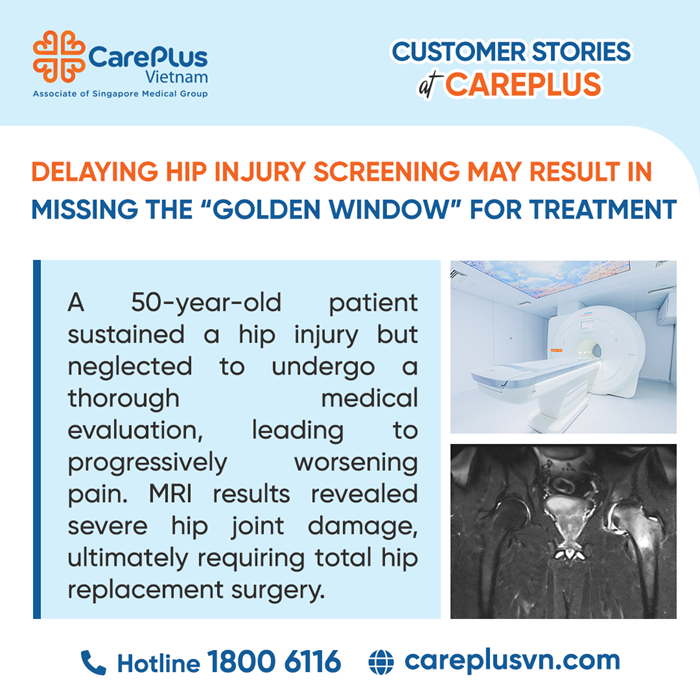
MRI revealed a significantly more severe condition than a typical sports injury:
- Collapse of the left femoral head at the weight-bearing region
- Subchondral bone involvement of both the femoral head and acetabulum (predominantly in weight-bearing areas), showing low signal intensity on T1-weighted images and mixed low-to-high signal on STIR sequences
- Extensive inflammatory response: Diffuse bone marrow edema extending from the femoral head down to the femoral neck and intertrochanteric region
- Hip joint effusion in the left hip
CLINICAL INTERPRETATION
From a comprehensive clinical perspective, the “misstep” was likely just a triggering event that unmasked an underlying condition that had been silently progressing:
- Underlying pathology: MRI findings are consistent with advanced Avascular Necrosis (AVN) of the femoral head. The femoral head had likely been ischemic and undergoing necrosis for a prolonged period without obvious early symptoms.
- Mechanism of collapse: Delayed medical evaluation, combined with repetitive high-impact stress from boxing (jumping, pivoting), placed excessive load on an already compromised bone structure, ultimately leading to femoral head collapse.
- Extensive bone marrow edema: The widespread edema extending to the femoral neck and intertrochanteric region represents an acute osseous response to structural collapse, explaining the severe pain and loss of mobility.
LOSS OF THE “GOLDEN WINDOW”
Delayed diagnosis in this case led to significant consequences. Early-stage interventions—highly effective in ARCO stages I and II—were no longer viable.
The disease had progressed to advanced stages (ARCO III and IV), characterized by joint destruction and irreversible femoral head deformity. At this stage, total hip replacement is often the only feasible treatment option.
THE VALUE OF MRI IN HIP JOINT ASSESSMENT
The hip joint is deeply located and surrounded by thick muscle layers, making early detection challenging with conventional imaging methods.
X-ray and ultrasound are often insufficient in detecting early-stage femoral head necrosis before structural changes occur.
MRI is the gold standard, capable of identifying early bone marrow edema and cellular necrosis—even before clinical symptoms become apparent.
In this case, MRI not only identified the underlying pathology (AVN) but also accurately assessed the extent of structural damage, enabling appropriate clinical decision-making.
EXPERT RECOMMENDATION: RIGHT IMAGING – ACCURATE DIAGNOSIS
This case highlights an important lesson: persistent joint pain—especially in deep joints such as the hip or knee—should never be underestimated.
Early specialist consultation combined with appropriate imaging modalities like MRI is key to early detection. Timely diagnosis not only helps preserve the natural joint but also minimizes treatment costs and protects long-term quality of life.