POSTERIOR SHOULDER PAIN: DON'T ASSUME IT'S JUST A MUSCLE STRAIN
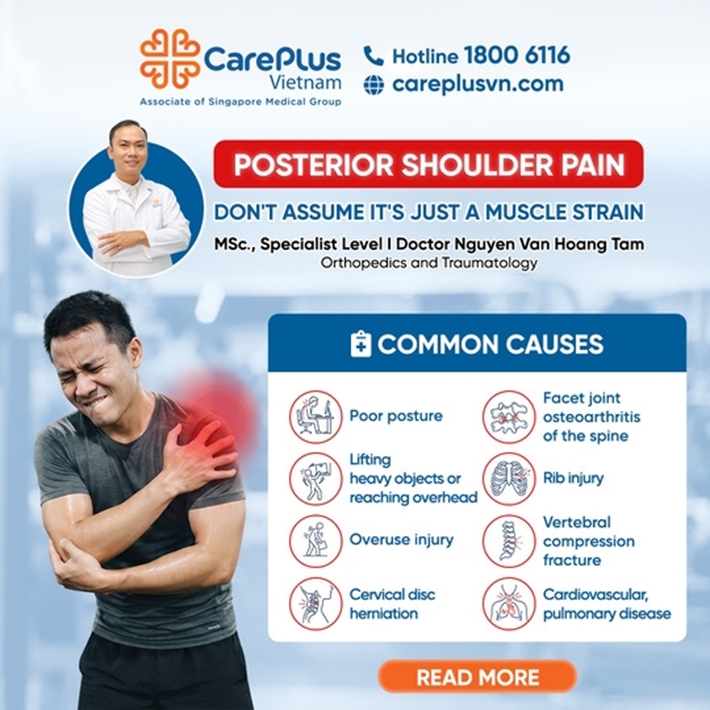
Posterior shoulder pain may not be just a muscle strain. It can also relate to posture, sports or spinal conditions. Explore its causes and when to see a doctor with CarePlus.
11/27/2026 2:52:52 PM
Have you ever felt a dull, sharp or burning pain at the back of your shoulder, around the shoulder blade (posterior shoulder pain)? Some people feel it after a gym session. Others notice it after playing badminton or tennis, or after swimming. For some, it follows a long day of sitting at work or looking down at their phone. Others have persistent pain that keeps coming back despite massage and medicated patches.
💡 Notably, posterior shoulder pain doesn't always start in the shoulder joint. Its causes range from posture and sports to spinal conditions and more serious health problems.
👨⚕️ Join Dr. Nguyen Van Hoang Tam, MD, MSc, specialist in Orthopedics and Trauma - Sports Medicine - Musculoskeletal Care at CarePlus International Clinics, to learn more in the article below.
1️⃣ Poor posture - A familiar but often overlooked cause
Prolonged slouched sitting, with head forward and shoulders rounded, can increase strain on the muscles and soft tissues of the neck, upper back and shoulder blade area.
Habits such as:
▪️ Looking down at your phone for long periods.
▪️ Hunching over while working at a computer.
▪️ Lying on your side with the lower arm stretched forward, pushing the shoulder blade outward.
Over time, the shoulder blade's supporting muscles and structures may be overloaded, causing a sharp pain, dull ache or burning sensation behind the shoulder.
2️⃣ Heavy lifting or overhead reaching
You may feel this pain when:
▪️ Lifting a suitcase or heavy box up high.
▪️ Performing overhead presses with excessive weight.
▪️ Lifting objects held too far from your body.
▪️ Repeatedly performing overhead movements.
These activities can strain muscles, injure ligaments or overload the structures around the shoulder and spine. In regular athletes especially, repeated overhead movements may be linked to other shoulder injuries, such as rotator cuff injuries.
3️⃣ Overuse injuries
More activity is not always better. Overusing the muscles and ligaments around the shoulder blade, or increasing activity before your body adapts, can cause posterior shoulder pain. Common activities include:
▪️ Painting ceilings or working with your arms overhead for long periods.
▪️ Gardening that involves repetitive movements.
▪️ Playing tennis, pickleball or other racket sports without an adequate fitness foundation.
Overload can cause muscle and ligament injuries or bursitis between the shoulder blade and chest wall (scapulothoracic bursitis). Some people may notice a crackling sound or a grating sensation in the shoulder blade during movement.
4️⃣ Cervical disc herniation
Many people don't think of this cause when the back of their shoulder hurts. A herniated disc in the lower cervical spine can compress or irritate a nearby nerve root, causing pain that radiates to the shoulder blade area.
The pain may:
▪️ Be dull or sharp.
▪️ Feel like burning.
▪️ Feel like an electric shock.
▪️ Come with numbness or tingling.
Notably, some people feel only posterior shoulder pain, with no obvious neck pain. So persistent pain or neurological symptoms call for checking the neck too, not just the shoulder joint.
5️⃣ Spinal facet joint osteoarthritis
Facet joints are small joints at the back of the spine that aid movement and stability. When they degenerate or become inflamed, they can cause pain that radiates to the back of the shoulder.
Patients often experience:
▪️ A dull, deep ache.
▪️ Pain that worsens when turning the neck or looking over the affected shoulder.
▪️ Sometimes, only posterior shoulder pain, with no obvious neck symptoms.
Consider this cause when the pain is associated with neck movement.
6️⃣ Rib injury or displacement
Certain rib injuries can cause sharp pain near the shoulder blade. This may occur after:
▪️ Trauma or a fall.
▪️ Overload from repetitive movements.
▪️ Overhead reaching.
The pain may worsen when raising your arm, twisting your torso or breathing deeply. If it follows an upper back injury, see a doctor to rule out rib or shoulder blade damage.
7️⃣ Vertebral compression fractures
A compression fracture can affect one or more vertebrae when the vertebral body weakens and collapses under force. Common features include:
▪️ Pain that comes on suddenly.
▪️ Pain that may ease with rest.
▪️ Tenderness when the injured area is touched. People with osteoporosis or osteopenia are at higher risk of vertebral compression fractures, sometimes after only very light activity or with no clearly remembered injury.
8️⃣ Other dangerous causes
Besides musculoskeletal causes, posterior shoulder pain can sometimes be a sign of heart or lung disease. Serious conditions to be aware of include:
🔸 Aortic dissection: can cause sudden, severe pain that spreads to the back or around the shoulder blade.
🔸 Heart attack (myocardial infarction): sometimes presents as pain in the upper back or shoulder, especially in women.
🔸 Pulmonary embolism: can cause back or shoulder pain and usually requires emergency assessment when accompanied by shortness of breath or other warning signs.
🚨 If posterior shoulder pain comes with chest pain, shortness of breath, sweating, dizziness or sudden, severe pain, go to an emergency facility immediately. Also, worsening pain, fever, chills, unexplained weight loss, numbness or weakness in the arm, or pain after injury should be assessed by a doctor.
🔎 Posterior shoulder pain - Finding the true source
Pain in one spot can originate from many different structures. So an exam shouldn't stop at the painful spot, but fully assess the cervical spine, nerves, shoulder blade, muscles, shoulder joint, ribs and thoracic spine.
🏥 At CarePlus, specialists in Orthopedics and Trauma - Sports Medicine - Musculoskeletal will review your symptoms, perform a musculoskeletal examination and carry out appropriate clinical tests to help identify the likely cause.
If needed, X-ray, ultrasound or MRI may be ordered to clarify the injury. Clients are then advised on treatment suited to the cause, severity and their activity needs.
👉 If this pain persists, recurs or affects your work, sleep or sports, see a doctor to have the cause properly assessed and get advice on suitable treatment.
📩 Message our fanpage or call the free hotline 1800 6116 to book an appointment today.