DON’T LET MINOR SKIN LESIONS TURN INTO MAJOR RIS
10/27/2026 4:05:14 PM
A long-standing burn scar, a mole that suddenly grows larger or irregular... it is all too easy to brush them off or self-medicate using old prescriptions. However, behind these seemingly minor changes lies the silent progression of skin cancer.
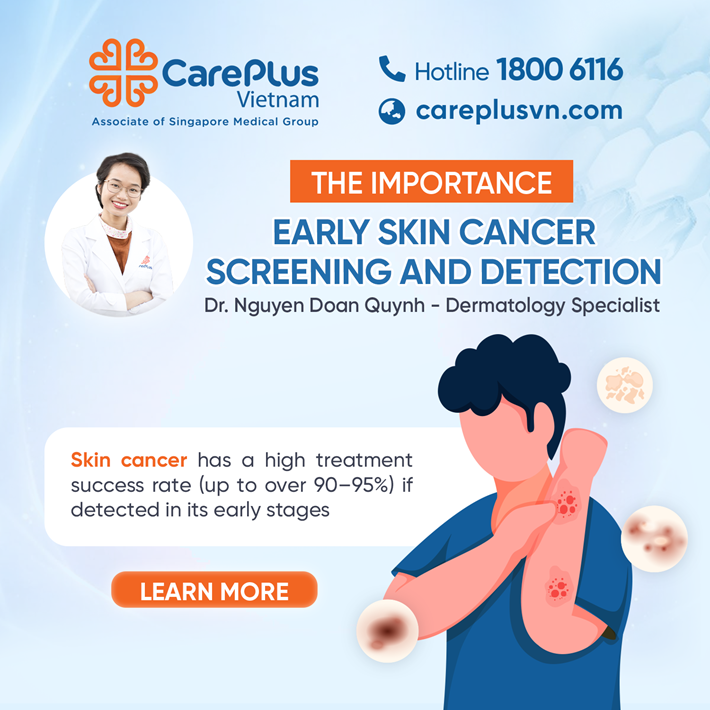
The Importance of Skin Cancer Screening & Early Detection
Skin cancer is one of the cancers with a remarkably high cure rate (over 90–95%) when detected at an early stage. Conversely, if allowed to progress into deeper layers or invade surrounding tissues, treatment becomes complex, resulting in significant scarring, high medical costs, and even life-threatening risks.
An old scar or mole requires immediate medical evaluation if it exhibits any of the following signs:
-
Long-standing burn scars: Noticeable changes on the surface, such as warty growths, ulcerations, or color alterations.
-
Moles: Changes following the ABCDE rule (Asymmetry, Border irregularity, Color variation, Diameter > 6mm, Evolving over time).
-
Non-healing ulcers: Wounds that persist for 2–4 weeks without healing.
A Real-Life Story: A Timely Warning from a 20-Year-Old Lesion
To truly appreciate the importance of never ignoring minor skin lesions, let us hear the story of an international patient in his 70s at CarePlus Dermatology Department.
-
Living with an old lesion for 20 years: The patient had suffered a thermal burn on the back of his lower leg. Since then, the lesion had been persistently red and scaly, and was diagnosed as eczema 20 years ago. For decades, whenever the area flaked heavily or itched, he reused his old prescription topical cream—even though it yielded no real improvement. He simply lived with the lesion, assuming it was a chronic inflammatory skin condition.
-
Doubt makes way for trust: During a visit to CarePlus for a routine wound dressing change following an accident, Dr. Nguyen Doan Quynh accidentally noticed a scaly red plaque with scattered small crusted ulcers on the back of his left leg. Recognizing signs suspicious of skin cancer, she urged him to get a biopsy. However, the patient initially refused, believing it was merely a long-standing lesion previously confirmed as eczema by multiple physicians.
Three months later, despite his skepticism, the patient visited another hospital to request a biopsy. The result: Squamous Cell Carcinoma in situ. He was promptly referred to an oncology hospital for wide excision and metastasis evaluation. Fortunately, the tumor was confined to the epidermal layer and had not yet invaded deeper structures.
-
Early detection through routine screenings: Following a successful surgery, the patient sent a thank-you letter to Dr. Quynh and committed to a regular skin cancer screening schedule every 6 months at CarePlus. This proactive approach paid off shortly after: during his second follow-up, Dr. Quynh identified a new mole on his chest. This time, without hesitation, he underwent an immediate biopsy as advised. The histopathology revealed Basal Cell Carcinoma. Because it was caught at a very small size before penetrating the basement membrane, treatment was straightforward and recovery was rapid.
Skin Biopsy at CarePlus: The First-Line Diagnostic & Screening Tool
Patients with risk factors—such as a personal or family history of skin cancer, fair skin, a history of sunburns, or compromised immunity—should pay extra attention to new skin lesions for early detection. Skin cancer often resembles a mole (ranging in color from dark brown, blue, red-pink, to flesh-toned) that displays asymmetry, irregular borders, uneven coloration, or recent evolution.
Skin cancer screening begins with self-examination. By monitoring the location, shape, and color of existing moles, patients can readily notice any changes and prompt a dermatologist to evaluate suspicious lesions.
During your consultation, the dermatologist will examine the lesion using a dermatoscope before deciding on a biopsy. The pathology results will establish a definitive diagnosis and guide subsequent treatment plans.
Skin Biopsy Process & Benefits
A skin biopsy is a minor procedure in which a small skin tissue sample is collected for microscopic examination to confirm a diagnosis and/or monitor treatment progress:
-
Fast & Safe Procedure: Conducted quickly while adhering strictly to infection control standards.
-
Reliable Histopathology Results: Accurately determines the nature of the lesion (benign, precancerous, or malignant), guiding further diagnostic steps or targeted therapy.
-
Long-Term Screening & Guidance: Includes post-procedure skin care advice and customized follow-up schedules for comprehensive, long-term skin health management.
Do not ignore any small changes on your skin! Contact CarePlus today to consult with our team of Dermatology Specialists and schedule your comprehensive skin assessment.