DIFFERENTIATING GOUT ARTHRITIS FROM RHEUMATOID ARTHRITIS
Learn how to tell the difference between gout and rheumatoid arthritis with CarePlus specialists - so you can recognize the signs early, get an accurate diagnosis, and receive the right treatment to protect your joint and musculoskeletal health.
6/9/2026 4:31:38 PM
Are you experiencing joint pain and swelling that makes it difficult to move and walk around… yet have no idea what's causing it? In reality, among the many causes of joint pain, gout and rheumatoid arthritis are two conditions that are frequently confused with each other - because their early symptoms can look remarkably similar.
👉 It is precisely this "uncertainty" that leads many people to self-diagnose or act on guesswork. That's why understanding your condition from the very beginning empowers you to take the right steps in caring for your musculoskeletal health - accurately and in a timely manner.
Join MSc. Dr. CKI. Nguyen Van Hoang Tam - Specialist in Orthopedic Trauma, Sports Medicine & Musculoskeletal Medicine at CarePlus - as we explore the key differences between gout arthritis and rheumatoid arthritis in the article below.
1️⃣ Why are gout and rheumatoid arthritis so often confused?
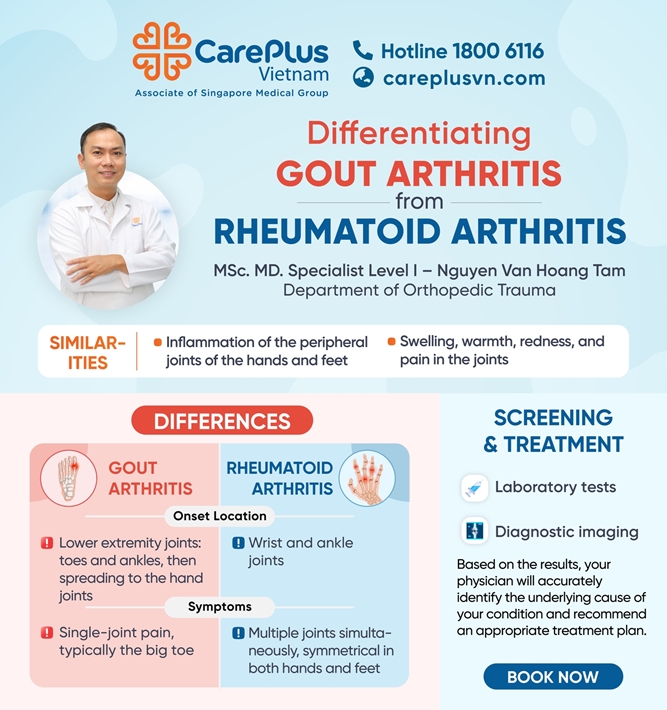
From a clinical perspective, both gout and rheumatoid arthritis are musculoskeletal conditions characterized by joint inflammation. What they share in common is that inflammation tends to originate in the peripheral joints (hands and feet) - presenting as swelling, warmth, redness, and pain in the joints of the fingers and toes.
2️⃣ How do gout and rheumatoid arthritis differ?
Despite their similar appearances, these two conditions differ significantly in both cause and the nature of the pain:
🔶 Gout: Inflammation typically begins in the lower-extremity joints, following the pattern of uric acid crystal deposition - for example, the toe joints and ankle, before potentially spreading to the joints of the hands. It most commonly strikes a single joint at a time - classically presenting as a hot, red, swollen, and excruciatingly painful big toe joint, often flaring up after a rich meal heavy in protein, such as a feast with alcohol, seafood, or similar foods.
🔷 Rheumatoid Arthritis: Inflammation typically originates in the joints of the wrists and hands (wrist joints, metacarpophalangeal joints, proximal interphalangeal joints) as well as the ankles and feet. It tends to affect multiple joints simultaneously, with a hallmark pattern of bilateral symmetry - involving both hands and both feet at once. Morning stiffness in the fingers and toes is usually the very first sign to appear.
3️⃣ Proactive screening for accurate diagnosis and timely treatment
The Musculoskeletal Department at CarePlus brings together a team of highly trained specialist physicians, state-of-the-art medical equipment, and an automated laboratory at each branch - delivering personalized examination, diagnosis, and treatment services for every patient.
🔬 For Gout: A blood uric acid level test serves as an early warning marker for the risk of gout.
🔬 For Rheumatoid Arthritis: Laboratory tests such as RF (Rheumatoid Factor) and Anti-CCP antibodies are key diagnostic markers for identifying this condition.
📸 Combined with imaging diagnostics: Joint ultrasound and X-ray of the affected joint can help evaluate the extent of joint damage - whether it is in an active inflammatory stage or has progressed to structural joint deformity.
Based on the results, our doctor will:
✔️ Accurately identify the underlying cause of your condition
✔️ Recommend a personalized treatment plan tailored to your specific needs
If you are experiencing unexplained joint pain, don't hesitate - visit CarePlus to be examined by our experienced and dedicated team of Orthopedic & Musculoskeletal specialists.
📞 Message our fanpage or call our free hotline 1800 6116 to book your appointment today.
CAREPLUS INTERNATIONAL CLINICS
Associate of Singapore Medical Group
Hotline: 1800 6116
Email: info@careplusvn.com
Fanpage: CarePlus Clinic Vietnam