NEW APPROACHES TO FATTY LIVER DISEASE TREATMENT: MORE THAN JUST DIETARY RESTRICTIONS - A PERSONALIZED CARE PLAN
10/21/2026 8:56:55 AM
“Fatty liver” is such a familiar term that many people assume:
“It’s nothing serious. I just need to lose a little weight.”
However, fatty liver disease does not always stop at fat accumulation in the liver.
In some people, particularly those who are overweight or obese, have type 2 diabetes, dyslipidemia, or other metabolic risk factors, the disease may progress to MASH (metabolic dysfunction-associated steatohepatitis), which can eventually lead to liver fibrosis.
AN IMPORTANT UPDATE IN TREATMENT
In November 2025, the American Association for the Study of Liver Diseases (AASLD) updated its guidance on semaglutide for the treatment of MASH.
According to this guidance, semaglutide may be considered for adults with noncirrhotic MASH and moderate-to-advanced liver fibrosis (stages F2–F3), with appropriate patient selection and treatment monitoring.
In the United States, Wegovy (semaglutide) has also received FDA approval for the treatment of MASH in adults with F2–F3 fibrosis. It is administered once weekly in combination with a reduced calorie diet and increased physical activity.
Compared with Resmetirom (brand name Rezdiffra), which may be relatively difficult to access and costly in the Vietnamese market, semaglutide may be more readily available and offers the convenience of once-weekly administration. It may also help patients manage their weight.
This represents another noteworthy treatment option.
However, one point is essential: not everyone with fatty liver disease should take semaglutide.
That is precisely why an accurate assessment of each patient's condition is so important before treatment begins.
FATTY LIVER DISEASE REQUIRES MORE THAN MEDICATION - IT NEEDS A COMPREHENSIVE MANAGEMENT PLAN
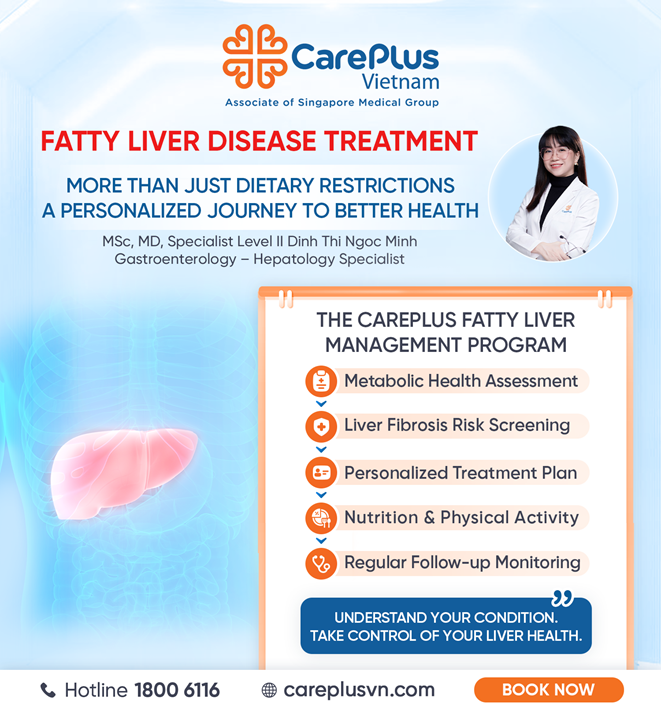
At CarePlus, the management of fatty liver disease follows a stepwise approach rather than relying solely on an ultrasound result or a single liver enzyme measurement.
ASSESSING METABOLIC HEALTH
Doctors assess relevant factors, including:
- Body weight, BMI, and waist circumference
- Blood glucose
- Blood lipids
- Liver enzymes and other necessary laboratory tests
- Associated metabolic conditions and indicators
Fatty liver disease rarely occurs in isolation. It is closely linked to overall metabolic health.
SCREENING FOR LIVER FIBROSIS RISK
Based on laboratory results, doctors may use screening tools such as the FIB-4 score to stratify the patient's initial risk.
The goal is not simply to answer: “Do I have fatty liver disease?” It is also to determine: “Am I at significant risk of liver fibrosis?”
When necessary, patients may undergo further assessment using appropriate liver stiffness measurement techniques.
DETERMINING DISEASE SEVERITY TO GUIDE TREATMENT
Once sufficient information is available, doctors assess the patient's overall liver health and metabolic risk factors to determine an appropriate management strategy.
This may include lifestyle modifications, weight management, dietary guidance, physical activity, or medication in selected cases.
Semaglutide is one of the treatment options that may be considered for eligible patients. It is not a medication for everyone with fatty liver disease.
NUTRITION IS NOT JUST ABOUT “GOING ON A DIET”
This is an area that deserves greater emphasis in CarePlus content.
Simply telling someone with fatty liver disease to “lose weight and eat healthily” may leave them wondering what to eat, how much weight to lose, and how long they need to maintain these changes.
At CarePlus, in addition to medical monitoring, patients can receive nutritional counseling to develop a plan tailored to their health status and weight-management goals.
For people with fatty liver disease, the goal is not simply to:
❌ Skip meals
❌ Drastically cut carbohydrates
❌ Force rapid weight loss
Instead, the focus is on:
✅ Maintaining an appropriate body weight
✅ Building sustainable eating habits
✅ Improving metabolic health
✅ Incorporating physical activity
✅ Monitoring progress and adjusting the plan at each stage
A good dietary plan is one that patients can maintain over the long term, not one they can follow for only a few weeks.
FOLLOW-UP MATTERS - FATTY LIVER DISEASE CANNOT BE MANAGED IN A SINGLE VISIT
The important question is not just:
“What is my condition today?”
It is also:
“How has my condition changed after 3, 6, or 12 months?”
Weight, waist circumference, metabolic laboratory results, fibrosis risk, and response to the treatment plan can be monitored regularly. This allows doctors and patients to adjust the management strategy when necessary.
FROM A “FATTY LIVER” DIAGNOSIS TO A COMPREHENSIVE CARE PATHWAY
At CarePlus, patients can access a care pathway that includes:
- Medical consultation and laboratory testing
- Liver fibrosis risk screening
- Further assessment when necessary
- Personalized treatment planning
- Appropriate nutrition and physical activity to support weight management
- Regular follow-up
With laboratory testing, appropriate assessment methods, structured follow-up, and nutritional counseling, the goal is not merely to detect fatty liver disease. It is to help patients understand their condition and establish a suitable long-term management plan.
FATTY LIVER DISEASE MAY GO UNNOTICED, BUT LIVER CARE SHOULD NEVER BE NEGLECTED.
Together, let's take control of fatty liver disease - starting with a better understanding of your own health.